
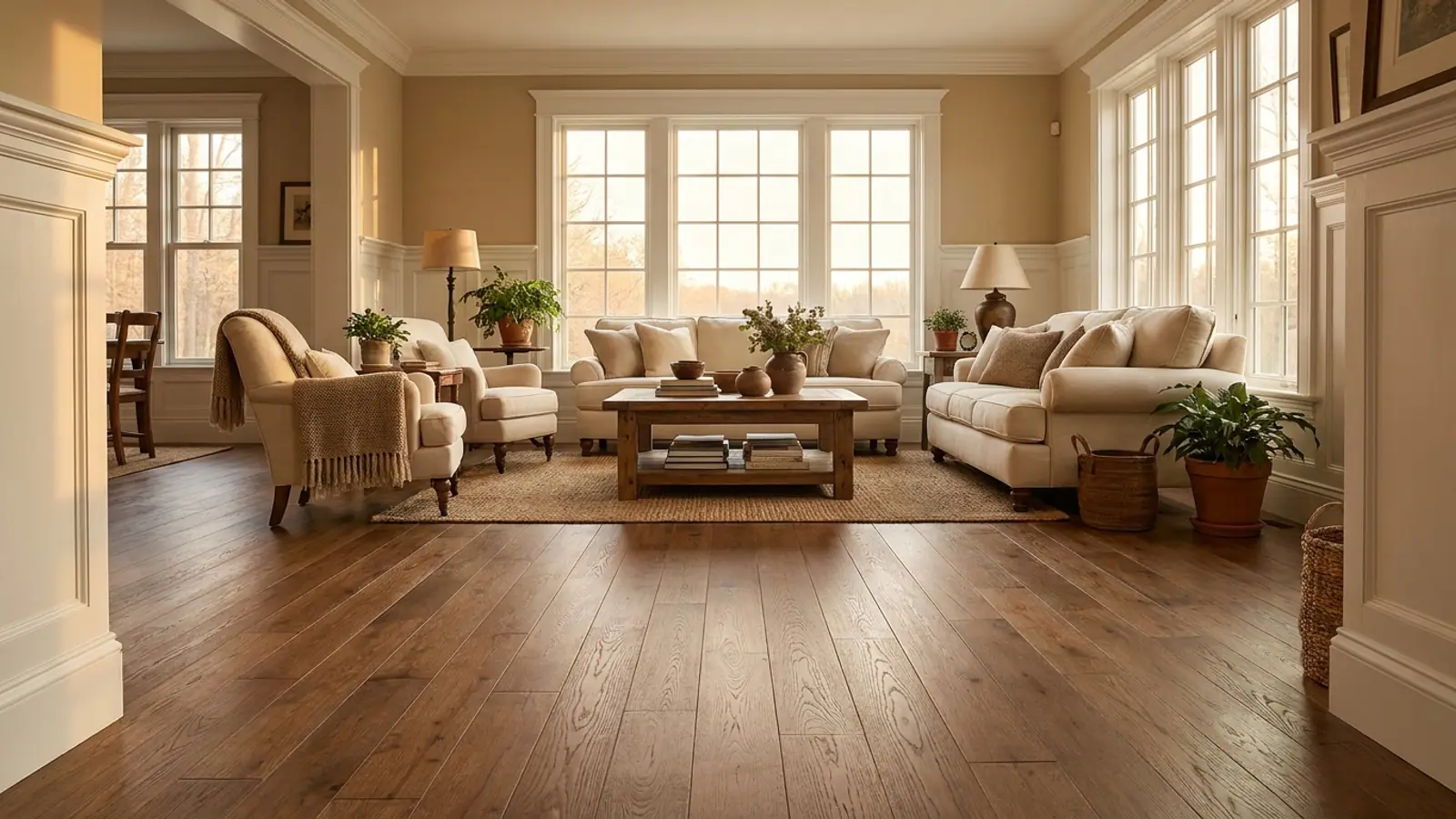
Engineered Wood Floor Installation in Statesboro, GA | Slab-Ready Engineered Experts
Engineered wood consists of a genuine hardwood wear veneer laminated over a cross-directional plywood or HDF core. Cross-lamination is the whole point. Alternating the grain direction restricts how much the board expands and contracts across its width. We install engineered flooring using floating click-lock assemblies, full-spread adhesive, and staple-down methods over wood subfloors. Veneer thickness determines refinishing potential, so we specify accordingly. A 2mm wear layer supports one careful sanding cycle, while 4mm to 6mm veneers tolerate two or three. Substrate flatness must fall within 3/16 inch across a 10 foot span before installation begins.
Engineered wood is the correct specification wherever concrete makes solid hardwood inadvisable. Slab-on-grade construction dominates newer neighborhoods throughout Statesboro, and engineered flooring performs reliably there when moisture is properly evaluated first. We install for homeowners, production builders, and commercial clients across Bulloch County and the surrounding counties. The aesthetic result is indistinguishable from solid hardwood because the visible surface is genuine hardwood. What differs is the substrate compatibility and the dimensional behavior through seasonal humidity swings, which in this climate is a meaningful engineering advantage.
Licensed & Insured · 50+ years experience
Request A Free Quote!
Tell us what you need. We reply the same working day.
Real hardwood surfaces, engineered for slab construction.
912-616-4723Why We are the Best flooring contractor in Statesboro, GA
Selecting a flooring contractor ultimately comes down to who actually shows up and who stands behind the installation afterward. We have installed flooring throughout Bulloch County for over 50 years, and the same crew handles your project from initial measure through final walkthrough. Subcontracted installation is where most flooring complaints originate, so we simply do not operate that way.
- Over 50 years delivering flooring installation, repair, and maintenance across residential and commercial properties throughout the region
- Full-service solutions including luxury vinyl plank, solid hardwood, engineered wood, porcelain tile, laminate, and broadloom carpet
- Skilled craftsmanship using precise installation methods including floating click-lock assemblies, full-spread glue-down, and traditional blind-nailed hardwood
- High-quality materials and factory-cured finishes selected to improve durability, appearance retention, and long-term dimensional performance
- Custom design options covering plank direction, seam placement, transition detailing, and stair treatments to match any interior
- Low-VOC adhesives and underlayment systems available on request for occupied residences, medical clinics, and sensitive environments
Get a written price for your engineered wood project
Send us the rooms and the approximate square footage and we will schedule a free in-home measure. You receive one written number covering material, labor, subfloor preparation, and disposal of the existing floor. That figure does not move afterward unless demolition exposes structural damage nobody could reasonably have anticipated.
- Free in-home measure with no obligation
- Licensed & Insured throughout Georgia
- 50+ years installing across Bulloch County
Request A Free Quote!
Tell us what you need. We reply the same working day.
Benefits and Applications of Engineered Wood
Engineered flooring solves the one problem that rules out solid hardwood in most new homes. That problem is moisture rising through a concrete slab.
Dimensional Stability
Cross-laminated construction restricts seasonal movement to roughly a third of what comparable solid stock exhibits. In southeast Georgia, where interior humidity swings between 35 and 65 percent across the year, that difference determines whether seams remain tight.
Wider planks benefit disproportionately. A 7 inch engineered plank remains dimensionally predictable where solid material of equivalent width would gap noticeably every winter. That is why nearly every wide-plank floor sold today is engineered rather than solid.
Slab Compatibility
Engineered flooring installs directly over concrete using either full-spread adhesive or a floating assembly over a vapor-retarding underlayment. Solid hardwood cannot do this reliably regardless of installation care.
Moisture testing remains mandatory beforehand. We evaluate the slab and specify an appropriate vapor retarder, because adhesive failure from unmitigated moisture is expensive and entirely preventable. Retrofitting a moisture barrier after the floor is down means removing everything first.
Veneer Thickness and Refinishing
Wear veneer thickness determines the flooring's renewable service life more than any other specification. Economy products carry roughly 0.6mm to 2mm, supporting a light screen-and-recoat but not aggressive sanding.
We generally recommend 4mm minimum for primary living areas. That thickness supports two full refinishing cycles, extending realistic service life well beyond twenty years. Bedrooms and low-traffic rooms tolerate thinner veneers without meaningful compromise.
Radiant Heat Applications
Engineered flooring is the only wood product we install over radiant heating systems. Its restricted dimensional movement tolerates the thermal cycling that would eventually destroy solid hardwood installed above the same assembly.
Surface temperature must remain below 85 degrees Fahrenheit at the flooring, and the system requires gradual commissioning before installation. We coordinate that sequence with your mechanical contractor directly. Exceeding that temperature will delaminate the veneer from its core over time.
Our Engineered Wood Installation Process
Installation method depends entirely on substrate. We determine that during the measure rather than assuming a default approach.
Moisture Evaluation
Concrete substrates undergo moisture testing before we specify any adhesive or underlayment system. Concrete continues releasing vapor for years following placement, and trapped moisture destroys adhesive bonds progressively.
Wood subfloors get metered instead, targeting 8 to 12 percent moisture content. The differential between subfloor and flooring should remain within 4 percent before installation proceeds. We record both readings so the manufacturer warranty stays intact if a claim ever arises.
Substrate Preparation
Flatness governs every installation method we use. We straightedge the entire area and correct deviations exceeding 3/16 inch across 10 feet using grinding or self-leveling compound.
Adhesive installations additionally require a clean, contaminant-free surface. Existing adhesive residue, curing compounds, and sealers all compromise bond strength and must be mechanically removed beforehand. Shot blasting or diamond grinding handles that, and we price it into the original quote.
Installation Method Selection
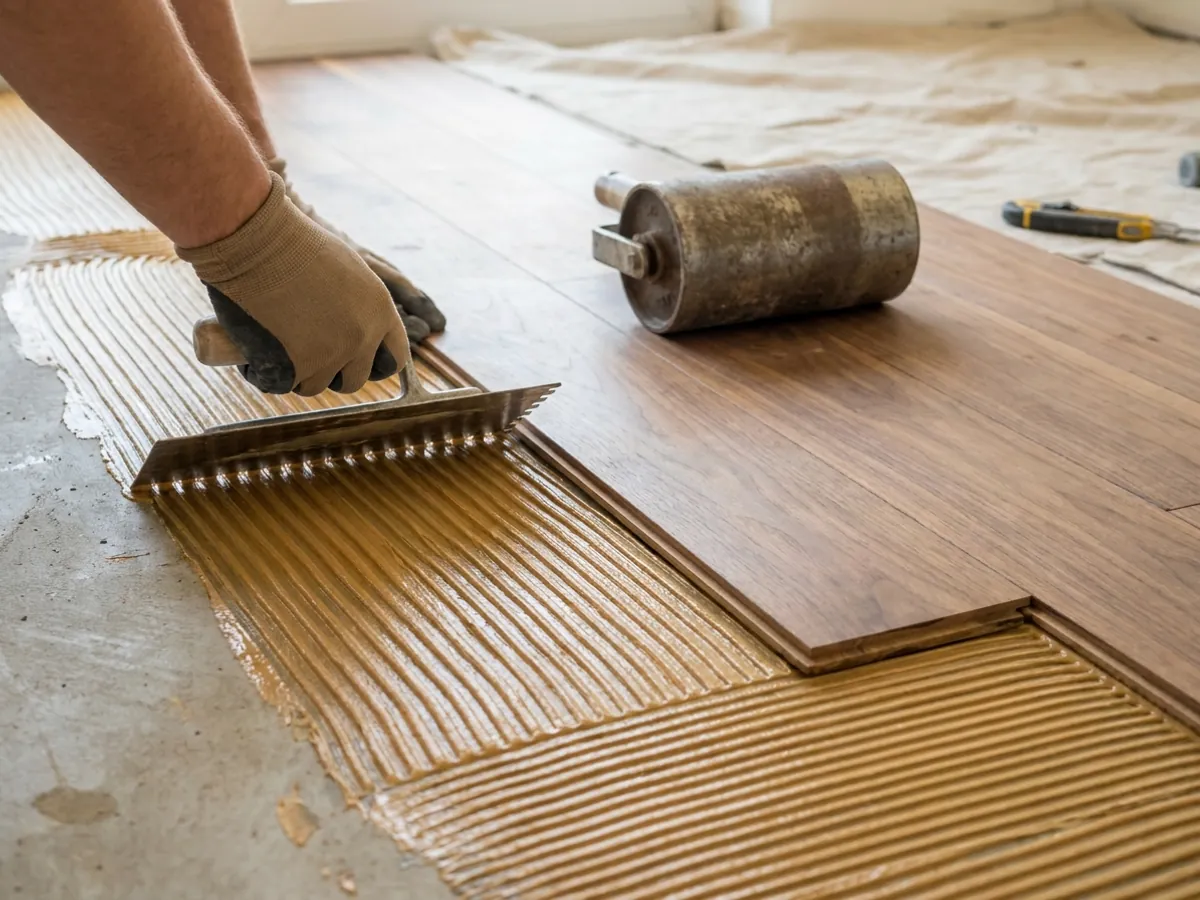
Full-spread adhesive delivers the most solid underfoot feel and eliminates the hollow acoustic signature floating assemblies sometimes produce. We trowel to the manufacturer's specified notch profile and roll the surface to guarantee transfer.
Floating installations suit renovations where substrate preparation would otherwise be prohibitive. Occupied homes also benefit, since floating assemblies eliminate adhesive odor entirely. See our floating floor installation page for the comparison in detail.
Types of Engineered Wood We Offer
Engineered products differ primarily in core construction and veneer specification. Both materially affect performance and price.
Plywood Core Construction
Multi-ply plywood cores, typically seven to eleven layers, deliver the best dimensional stability and fastener retention available in engineered flooring. This construction accepts staple-down installation over wood subfloors reliably.
Plywood cores also tolerate humidity fluctuation better than alternatives, which is precisely why we specify them for coastal-plain properties. The added cost over a fiberboard core is modest against the difference in service life.
HDF Core Construction
High-density fiberboard cores cost less and deliver excellent flatness, making them common in floating click-lock products. The trade-off is moisture vulnerability, since HDF swells irreversibly when water penetrates the joints.
We avoid specifying HDF-core products for kitchens, laundry rooms, and bathrooms. Bedrooms and formal living rooms are where HDF cores make genuine economic sense. For those spaces luxury vinyl plank is the more defensible choice.
Surface Treatments and Finishes
Wire-brushed and hand-scraped surface textures disguise everyday wear considerably better than smooth finishes. That matters in households with dogs or heavy traffic patterns.
Factory-applied aluminum oxide finishes cure harder than any site-applied coating and typically carry longer wear warranties. The trade-off is that spot repairs blend less convincingly than on site-finished floors. We keep a carton of attic stock on hand for that reason wherever storage allows.
Why Statesboro Flooring Company Is the Best Engineered Wood Floor Installation Expert
Local Expertise in Statesboro, GA
Slab-on-grade construction dominates the newer neighborhoods around Statesboro, particularly along the Burkhalter and Cawana Road corridor. Engineered flooring is the appropriate specification for those properties, and we have installed it across Bulloch County for over 50 years. We test every slab before recommending an adhesive system.
Professional Installers
Adhesive installations are unforgiving of technique. Our installers trowel to the manufacturer's specified notch profile and roll the surface within the adhesive's open time. Skipping the roller is the most common reason engineered floors develop hollow spots within the first year.
Commitment to Customer Satisfaction
You receive one written price covering material, labor, substrate preparation, and disposal of the existing floor. We walk the completed installation with you before loading out, and we leave the manufacturer maintenance schedule for the specific product installed.
Frequently Asked Questions About Engineered Wood Floor Installation
Installed engineered wood ranges from $6 to $12 per square foot throughout Bulloch County. Veneer thickness drives most of that spread, with 2mm economy products at the lower boundary and 4mm to 6mm European oak considerably higher. Adhesive installations cost more than floating assemblies because material and labor both increase. Substrate preparation adds $2 to $5 per square foot where a slab requires grinding or leveling. There is no charge for the measure or the written estimate.
Engineered wood consists of a genuine hardwood wear veneer bonded over a cross-directional plywood or high-density fiberboard core. That alternating grain orientation restricts expansion across the board's width to roughly a third of comparable solid stock. Compatible species include white oak, red oak, hickory, maple, and walnut. The governing installation requirement is substrate flatness within 3/16 inch across any 10 foot span, measured before material arrives.
A 1,500 square foot residence generally requires two to four working days. Acclimation adds 48 to 72 hours beforehand, which is meaningfully shorter than solid hardwood demands because the cross-laminated core stabilizes faster. Adhesive installations need 12 to 24 hours of cure time before heavy furniture returns to the space. Floating click-lock assemblies are the fastest variant, since they eliminate adhesive cure entirely.
Yes, and that capability is its primary advantage over solid hardwood. Engineered flooring installs over concrete using full-spread adhesive or as a floating assembly above a vapor-retarding underlayment. It also installs over plywood, OSB, and existing sound flooring. Slab flatness must fall within 3/16 inch over 10 feet. The exception we do not recommend is installation over slabs with unresolved moisture intrusion, which no product tolerates.
We specify a multi-ply plywood core carrying a 4mm minimum wear veneer with a factory-applied aluminum oxide finish. That combination survives commercial foot traffic while retaining refinishing capacity for later. Boutique retail, professional offices, hospitality lobbies, and conference spaces are typical applications. For higher traffic environments we would recommend commercial flooring installation in a resilient product instead. Call us and we will assess the space.
Get a written engineered wood price this week.
912-616-4723