
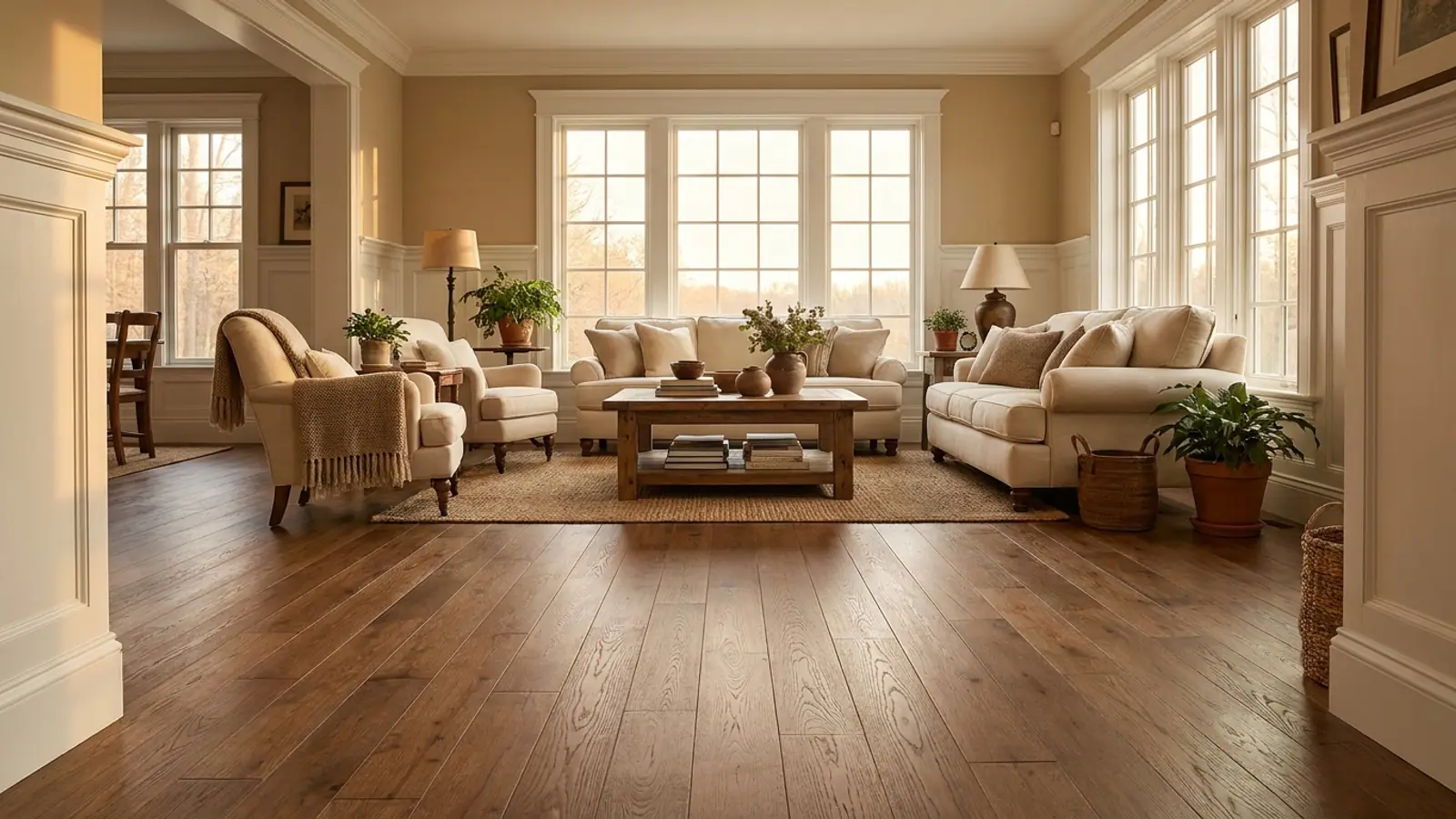
Glue-Down Flooring Installation in Statesboro, GA | Full-Spread Adhesive Experts
Glue-down installation bonds each board directly to the substrate with a full-spread adhesive troweled to the manufacturer's specified notch profile. The result is a floor with no movement underfoot, no hollow acoustic signature, and no expansion field limits. We install glue-down luxury vinyl tile, engineered wood, and commercial sheet goods. Substrate requirements are stricter than any floating method demands. The surface must be clean, structurally sound, free of curing compounds and old adhesive, and flat within 3/16 inch over 10 feet. We verify coverage by lifting set pieces periodically rather than assuming transfer occurred.
Glue-down is the correct method wherever rolling loads, large open spans, or heavy traffic rule out a floating assembly. Commercial buildings across Statesboro run on it for that reason, and so do residential great rooms too large for a single floating field. We install for commercial property managers, builders, and homeowners throughout Bulloch County. The trade-offs are honest ones. Adhesive requires cure time before heavy furniture returns, removal later is considerably more labor intensive, and the substrate work costs more up front than a floating installation would.
Licensed & Insured · 50+ years experience
Request A Free Quote!
Tell us what you need. We reply the same working day.
Solid underfoot, built for traffic and rolling loads.
912-616-4723Why We are the Best flooring contractor in Statesboro, GA
Selecting a flooring contractor ultimately comes down to who actually shows up and who stands behind the installation afterward. We have installed flooring throughout Bulloch County for over 50 years, and the same crew handles your project from initial measure through final walkthrough. Subcontracted installation is where most flooring complaints originate, so we simply do not operate that way.
- Over 50 years delivering flooring installation, repair, and maintenance across residential and commercial properties throughout the region
- Full-service solutions including luxury vinyl plank, solid hardwood, engineered wood, porcelain tile, laminate, and broadloom carpet
- Skilled craftsmanship using precise installation methods including floating click-lock assemblies, full-spread glue-down, and traditional blind-nailed hardwood
- High-quality materials and factory-cured finishes selected to improve durability, appearance retention, and long-term dimensional performance
- Custom design options covering plank direction, seam placement, transition detailing, and stair treatments to match any interior
- Low-VOC adhesives and underlayment systems available on request for occupied residences, medical clinics, and sensitive environments
Get a written price for your glue-down floors project
Send us the rooms and the approximate square footage and we will schedule a free in-home measure. You receive one written number covering material, labor, subfloor preparation, and disposal of the existing floor. That figure does not move afterward unless demolition exposes structural damage nobody could reasonably have anticipated.
- Free in-home measure with no obligation
- Licensed & Insured throughout Georgia
- 50+ years installing across Bulloch County
Request A Free Quote!
Tell us what you need. We reply the same working day.
Benefits and Applications of Glue-Down Flooring
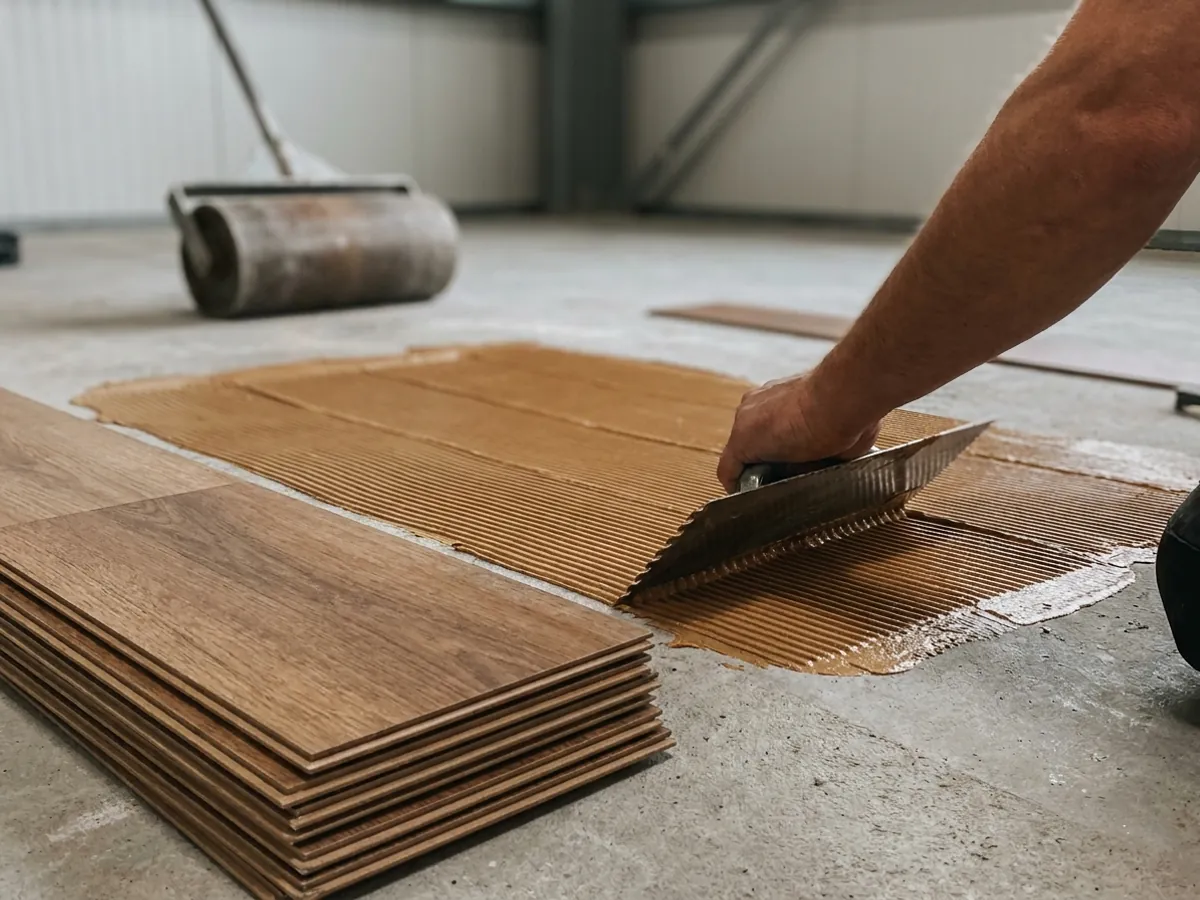
Glue-down costs more to install and more to remove. What it buys you is a floor that behaves like part of the building rather than a layer sitting on top of it.
Stability Under Rolling Loads
Office chairs, carts, and hospital equipment apply concentrated rolling loads that work floating assemblies apart over time. A bonded floor transfers that load straight into the substrate instead of into a locking joint.
This is the single strongest argument for glue-down in commercial buildings. Clinics, offices, and retail floors with fixture traffic all justify the additional installation cost within a few years of service. Replacing a failed floating floor in a busy office costs far more than bonding it correctly the first time. The math favours glue-down quickly.
No Expansion Field Limits
Floating floors need intermediate transitions roughly every 40 feet in any direction. A bonded floor has no such limit, so a large open plan runs unbroken from wall to wall with no T-moldings interrupting the field.
Open-concept homes and commercial spaces over 2,000 square feet benefit most. Removing those transition strips genuinely changes how a large space reads visually.
Sound and Feel Underfoot
Bonded floors eliminate the slightly hollow acoustic response that floating assemblies produce, particularly over concrete. The floor feels solid because it is mechanically continuous with the slab beneath it.
That difference is most noticeable in large rooms and in buildings where sound transmission matters. Recording spaces, clinics, and quiet offices are the usual cases where owners specifically request it. Multi-story buildings also benefit, since bonded assemblies transmit less impact noise to the floor below. Tenants notice that difference immediately.
Our Glue-Down Installation Process
Adhesive is unforgiving. Every failure we get called to inspect traces back to substrate contamination, moisture, or coverage that was never verified.
Substrate Cleaning and Testing
Concrete gets tested for moisture before any adhesive is specified, because trapped vapor breaks the bond progressively from underneath. Existing adhesive residue, curing compounds, sealers, and paint all have to come off first.
Shot blasting or diamond grinding handles that mechanical removal. We price it into the original quote wherever the substrate is visible during the measure, so it does not appear later as a change order.
Adhesive Selection and Trowel Notch
Adhesive choice follows the flooring product and the substrate, not habit. Pressure-sensitive adhesives suit modular vinyl, while hard-set urethanes handle engineered wood and moisture-prone slabs considerably better.
Trowel notch profile is specified by the manufacturer and it is not optional. The wrong notch delivers either insufficient coverage or adhesive squeeze-up through the seams, and both fail inspection.
Open Time, Rolling, and Coverage
Adhesive has a working window between spreading and losing tack, generally 20 to 60 minutes depending on product and conditions. Material set outside that window never bonds properly regardless of how it looks.
We roll the finished surface with a weighted roller to guarantee transfer, then lift set pieces periodically to verify coverage exceeds 85 percent. That verification takes minutes and prevents hollow spots entirely.
Materials We Install Glue-Down
Three product families install with full-spread adhesive. Each has a specific reason for choosing the bonded method over a floating one.
Glue-Down Luxury Vinyl Tile
Glue-down LVT is thinner and more flexible than rigid core products, which lets it follow minor substrate contour rather than bridging it. It is the standard specification for commercial installations over roughly 2,000 square feet.
Modular format also means a damaged tile lifts out individually. That repairability matters more in commercial buildings than the marginal cost difference does. Keeping a case of attic stock makes those repairs effectively invisible years later.
Glue-Down Engineered Wood
Engineered wood bonded to a slab delivers a genuine hardwood surface with the solid feel of a nailed floor. It eliminates both the hollow sound and the field size limits that floating installation carries.
Urethane adhesives are standard here because they tolerate slab moisture better than acrylics. Compare with engineered wood floor installation for the full product picture.
Commercial Sheet Goods
Sheet vinyl and homogeneous commercial flooring install fully bonded with heat-welded or chemically welded seams. That construction produces a genuinely monolithic surface with no joints for moisture to enter.
Clinics, labs, and food service areas specify it for exactly that reason. Our commercial flooring installation page covers those environments in more detail.
Why Statesboro Flooring Company Is the Best Glue-Down Flooring Installation Expert
Local Expertise in Statesboro, GA
Slab construction dominates commercial buildings and newer neighborhoods around Statesboro, and slab moisture is the variable that decides whether an adhesive bond holds. We test every slab before specifying a system. Fifty years of working Bulloch County substrates means we know which building eras tend to hide curing compounds.
Professional Installers
Our installers trowel to the specified notch, work inside the adhesive open time, and roll every installation. They also lift set pieces to verify coverage rather than assuming it transferred. Unverified coverage is the reason most glue-down floors develop hollow spots in the first year.
Commitment to Customer Satisfaction
You receive one written price covering substrate preparation, adhesive, material, labor, and disposal. We tell you the cure schedule in writing so you know exactly when heavy furniture can return. Anything not right at the walkthrough gets corrected before we leave the site.
Frequently Asked Questions About Glue-Down Flooring Installation
Installed glue-down flooring runs $5 to $12 per square foot across Bulloch County. Labor is higher than floating installation because adhesive work and rolling add time. Substrate preparation drives the rest, and shot blasting or grinding a contaminated slab adds $2 to $5 per square foot. Commercial sheet goods with welded seams price toward the upper boundary. Our in-home or on-site measure and written estimate carry no charge.
Glue-down installation bonds each piece directly to the substrate using a full-spread adhesive troweled to a specified notch profile. Compatible materials include luxury vinyl tile, engineered wood, and commercial sheet goods. The result has no movement underfoot and no expansion field limits. The governing requirement is a clean, sound substrate flat within 3/16 inch over 10 feet, with moisture verified before any adhesive is selected.
A 1,500 square foot area generally takes three to five working days including substrate preparation. Adhesive needs 12 to 24 hours before light foot traffic and 48 to 72 hours before heavy furniture or rolling loads return. Substrate grinding can add a full day by itself. Glue-down is the slowest resilient method we install, and compressing the cure schedule is how installations fail early.
Sometimes, but far less often than floating floors can. Adhesive needs a clean, porous, structurally sound surface, so existing tile must be abraded and old adhesive fully removed. It bonds well to prepared concrete, plywood, and cement backer board. The exception we do not recommend is bonding over existing sheet vinyl or any cushioned product, because the adhesive fails at the weaker layer beneath.
We specify glue-down luxury vinyl tile with a 20 mil or heavier wear layer for most commercial applications. It handles rolling loads, permits individual tile replacement, and installs without field size limits. Offices, retail floors, and clinics are typical. For labs, food service, and medical environments we specify homogeneous sheet vinyl with heat-welded seams instead. Call and we will spec the right build.
Get a written glue-down price this week.
912-616-4723