

Floating Floor Installation in Statesboro, GA | Click-Lock Floating System Experts
A floating floor is any assembly where the flooring locks to itself rather than fastening to the substrate below. Modern systems use angle-tap or drop-lock mechanical profiles milled into each board edge. We install floating rigid core vinyl, laminate, and engineered wood, always over an underlayment that provides cushioning and vapor retardance. The assembly relies on continuous perimeter expansion space, normally 1/4 inch at every wall and fixed obstruction. Substrate flatness must fall within 3/16 inch across a 10 foot span, because an unsupported span puts bending stress directly onto the locking joint.
Floating installation is the right method for renovations where substrate preparation would otherwise be prohibitive. It goes down over existing tile, sheet vinyl, and concrete without adhesive, which keeps occupied homes livable during the work. We install throughout Statesboro and across Bulloch County for homeowners, landlords, and renovation contractors. The method has genuine limits worth stating plainly. Very large open spans need intermediate transitions, and floating assemblies produce a slightly hollower sound underfoot than glued installations. We explain both trade-offs at the estimate rather than afterward.
Licensed & Insured · 50+ years experience
Request A Free Quote!
Tell us what you need. We reply the same working day.
Fast, low-disruption floors for occupied homes.
912-616-4723Why We are the Best flooring contractor in Statesboro, GA
Selecting a flooring contractor ultimately comes down to who actually shows up and who stands behind the installation afterward. We have installed flooring throughout Bulloch County for over 50 years, and the same crew handles your project from initial measure through final walkthrough. Subcontracted installation is where most flooring complaints originate, so we simply do not operate that way.
- Over 50 years delivering flooring installation, repair, and maintenance across residential and commercial properties throughout the region
- Full-service solutions including luxury vinyl plank, solid hardwood, engineered wood, porcelain tile, laminate, and broadloom carpet
- Skilled craftsmanship using precise installation methods including floating click-lock assemblies, full-spread glue-down, and traditional blind-nailed hardwood
- High-quality materials and factory-cured finishes selected to improve durability, appearance retention, and long-term dimensional performance
- Custom design options covering plank direction, seam placement, transition detailing, and stair treatments to match any interior
- Low-VOC adhesives and underlayment systems available on request for occupied residences, medical clinics, and sensitive environments
Get a written price for your floating floors project
Send us the rooms and the approximate square footage and we will schedule a free in-home measure. You receive one written number covering material, labor, subfloor preparation, and disposal of the existing floor. That figure does not move afterward unless demolition exposes structural damage nobody could reasonably have anticipated.
- Free in-home measure with no obligation
- Licensed & Insured throughout Georgia
- 50+ years installing across Bulloch County
Request A Free Quote!
Tell us what you need. We reply the same working day.
Benefits and Applications of Floating Floors
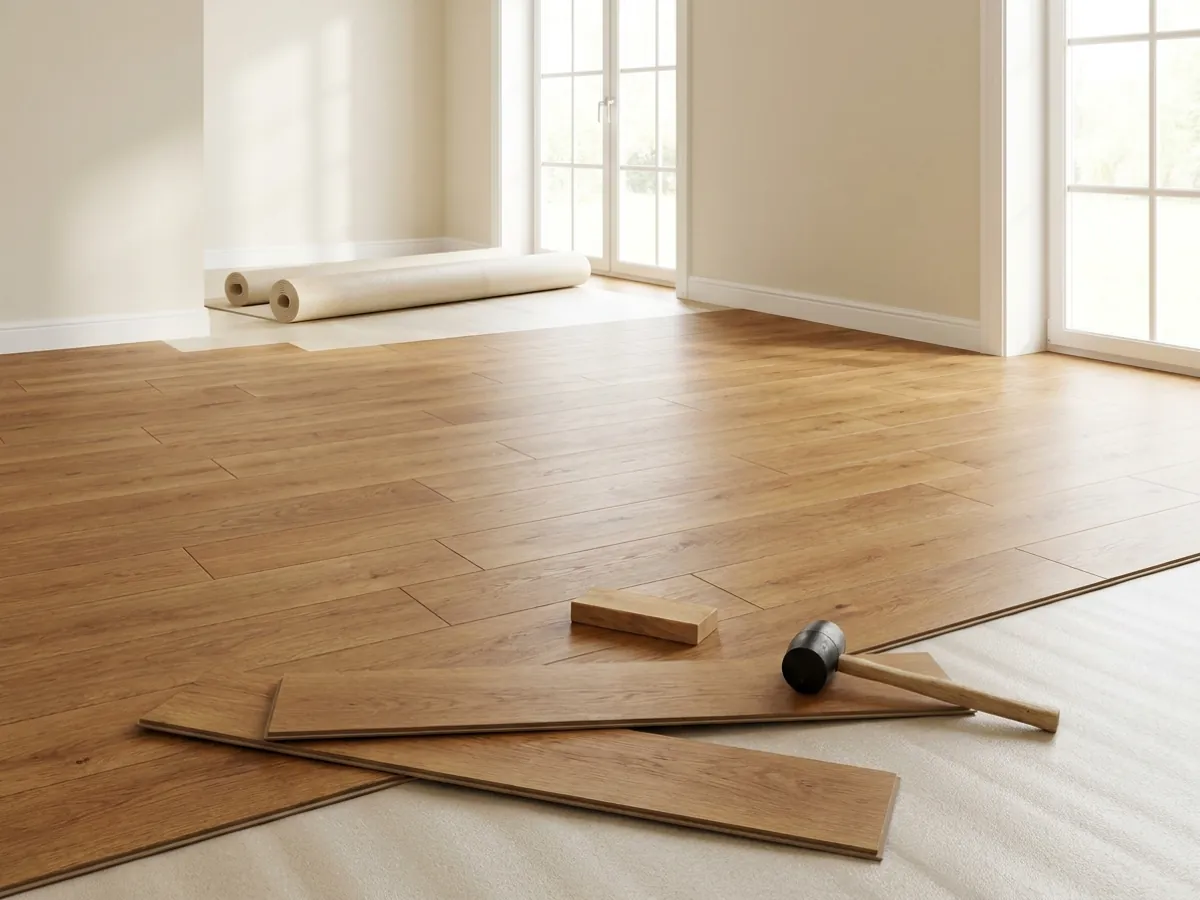
Floating systems dominate renovation work for one practical reason. They eliminate adhesive, and adhesive is what makes a flooring job disruptive to live through.
Speed and Low Disruption
A floating floor needs no adhesive cure time, so furniture returns to the room the same day installation finishes. Our crews routinely cover 300 to 800 square feet in a single working day once the substrate is ready.
That speed matters most in occupied homes and in rental turnovers with a fixed move-in date. There is no solvent odor and no restricted access period afterward, which lets a family stay in the house throughout.
Installing Over Existing Floors
Floating assemblies install over ceramic tile, sheet vinyl, plywood, and concrete without removing the existing surface, provided it is sound and flat. Skipping demolition removes both labor cost and disposal fees from the quote.
Grout lines deeper than 1/8 inch need filling first, or they telegraph through the finished floor as visible depressions. We check that during the measure and price the skim coat if it is needed.
Repairability and Reuse
Because nothing is bonded down, damaged boards can be unlocked and replaced individually. On a click-lock system a board near a wall takes minutes, though boards in the middle of a room require working back from the nearest edge.
The assembly can also be lifted and reinstalled elsewhere, which occasionally matters for tenants or for staged renovations. Glued floors offer no comparable option once they are down. That flexibility is worth real money on a property you intend to sell or re-let.
Our Floating Floor Installation Process
Floating floors fail in predictable ways, and every one of those failures traces back to expansion space or substrate flatness.
Substrate Flatness
We straightedge the entire area and correct any deviation exceeding 3/16 inch across a 10 foot span. Rigid core planks bridge a dip rather than following it, which loads the locking joint until it eventually fractures.
High spots get ground down and low spots get filled with self-leveling compound. On concrete this preparation frequently costs more than the flooring labor itself, and we price it into the original written quote.
Underlayment and Vapor Control
Underlayment cushions the assembly, dampens sound transmission, and on concrete provides vapor retardance. Products with attached pad still need a separate 6 mil vapor retarder over any slab, which installers skip more often than they should.
Upstairs rooms and multi-family units benefit from an acoustic underlayment rated for impact insulation. We specify that wherever sound transmission between levels is a genuine concern for the owner.
Expansion Space and Transitions
Every floating floor gets a continuous 1/4 inch perimeter gap at walls, cabinet bases, door casings, and any fixed obstruction. That gap is concealed behind base or quarter round, never filled with caulk or adhesive.
Runs exceeding roughly 40 feet in either direction need an intermediate expansion joint under a T-molding. Open-concept homes often require one transition where a single unbroken run would otherwise exceed the manufacturer limit.
Types of Floating Systems We Install
Three product families install as floating assemblies. Each behaves differently once water or heavy traffic is involved.
Rigid Core Vinyl
Rigid core vinyl is the most common floating product we install and the most forgiving in this climate. It is waterproof through its full thickness, so a plumbing failure does not destroy the assembly the way it would a fiberboard core.
SPC and WPC constructions both float well. Our luxury vinyl plank installation page covers the difference between those cores in detail.
Laminate Systems
Laminate floats over underlayment and delivers convincing wood aesthetics at the lowest installed cost of the three. Surface hardness is genuinely excellent, frequently exceeding site-finished hardwood on scratch resistance.
The fiberboard core is the limitation, since it swells permanently once water reaches the joints. See laminate flooring installation for where that trade-off makes sense.
Floating Engineered Wood
Engineered wood with a click-lock profile floats over underlayment and gives you a genuine hardwood surface without adhesive. It suits slab construction where solid hardwood is not an option and full-spread adhesive is not desired.
Floating engineered wood sounds slightly hollower underfoot than a glued installation. Where that matters we recommend glue-down installation instead.
Why Statesboro Flooring Company Is the Best Floating Floor Installation Expert
Local Expertise in Statesboro, GA
Many Statesboro renovations involve covering existing tile or sheet vinyl rather than removing it, and floating systems are what make that economical. We have installed them across Bulloch County for over 50 years. Humidity here also makes expansion allowance more consequential than manufacturer literature written for temperate regions suggests.
Professional Installers
Our installers maintain full perimeter expansion rather than tightening the last row to avoid a cut. They also verify substrate flatness with a straightedge before the first board rather than trusting the eye. Those two habits prevent nearly every floating floor failure we get called to inspect.
Commitment to Customer Satisfaction
You receive one written price covering material, underlayment, substrate preparation, installation, and disposal. Because there is no cure time, we walk the finished floor with you and your furniture goes back the same day. Anything not right gets corrected before we load out.
Frequently Asked Questions About Floating Floor Installation
Installed floating floors run $3.50 to $9 per square foot across Bulloch County, depending entirely on the product selected. Laminate sits at the lower boundary, rigid core vinyl in the middle, and floating engineered wood at the top. Labor is generally lower than glue-down because there is no adhesive or roller work. Substrate leveling adds $2 to $5 per square foot where it is required. Our measure and written estimate are free.
A floating floor is an assembly where boards lock to each other rather than fastening to the substrate beneath. Modern products use angle-tap or drop-lock mechanical edge profiles milled into each plank. Compatible materials include rigid core vinyl, laminate, and engineered wood. The governing requirement is substrate flatness within 3/16 inch across any 10 foot span, because unsupported spans place bending stress directly on the locking joints.
A single room is typically one working day. Expect two to three days for a 1,500 square foot residence, including tear-out and substrate preparation. Material acclimates in the space for 48 hours beforehand, which cannot be compressed. Floating installation is the fastest method we offer because there is no adhesive cure period, so furniture returns to the room the same day the crew finishes.
Yes, provided the tile is sound and fully bonded. Floating assemblies install over ceramic, sheet vinyl, plywood, and concrete without demolition. Grout joints deeper than 1/8 inch need skim filling first or they telegraph through as visible lines. Overall flatness must fall within 3/16 inch over 10 feet. The exception we do not recommend is floating over carpet or any cushioned surface, because the flex destroys the locking joints.
We specify SPC rigid core vinyl with a 20 mil wear layer for light commercial floating installations. The mineral core handles rolling chair loads far better than foamed or fiberboard alternatives. Offices, small retail units, and clinics are typical applications. For spans over roughly 2,000 square feet we usually move to glue-down instead, since large floating fields need intermediate transitions. Call and we will spec the right approach.
Get a written floating floor price this week.
912-616-4723